How it was made
Some of the measurements that decided this instrument are below, including the ones that ruled out what I wanted to do.
The library
152 presets in 14 collections, and the collections are lineages rather than folders of adjectives. Bay Legacy is 34 patches tracing the Bay's synth vocabulary; Funk Legacy is 18 behind it; Bay Bounce is 15; The Town is 5; The New Coast is 10, closing the line at the present day. Every patch is named for the job it does in a track, and the conventions hold across the whole bank: velocity opens the filter, the mod wheel carries the vibrato, the four macros move what that sound needs moved. You can play a whole collection from the arrows without meeting a patch that behaves differently from its neighbours.
The chord engine speaks the same dialect. Four of its fourteen types — m9, maj9, 9 and 13 — are rootless, because in this music the bass owns the root and the chord instrument plays colour tones only. The voice budget agreed: a rooted m9 is five notes, rootless is four, and the engine allows four. When the musical reason and the structural one arrive at the same answer, the decision is usually right.
m9 and maj9 are adjacent in the list deliberately. One parameter step flips the parallel minor to the major colour — a move that automates, and MIDI-learns, for free.
The bank, counted
152 presets, 14 collections. No filler, no four-hundred-patch pad drawer.
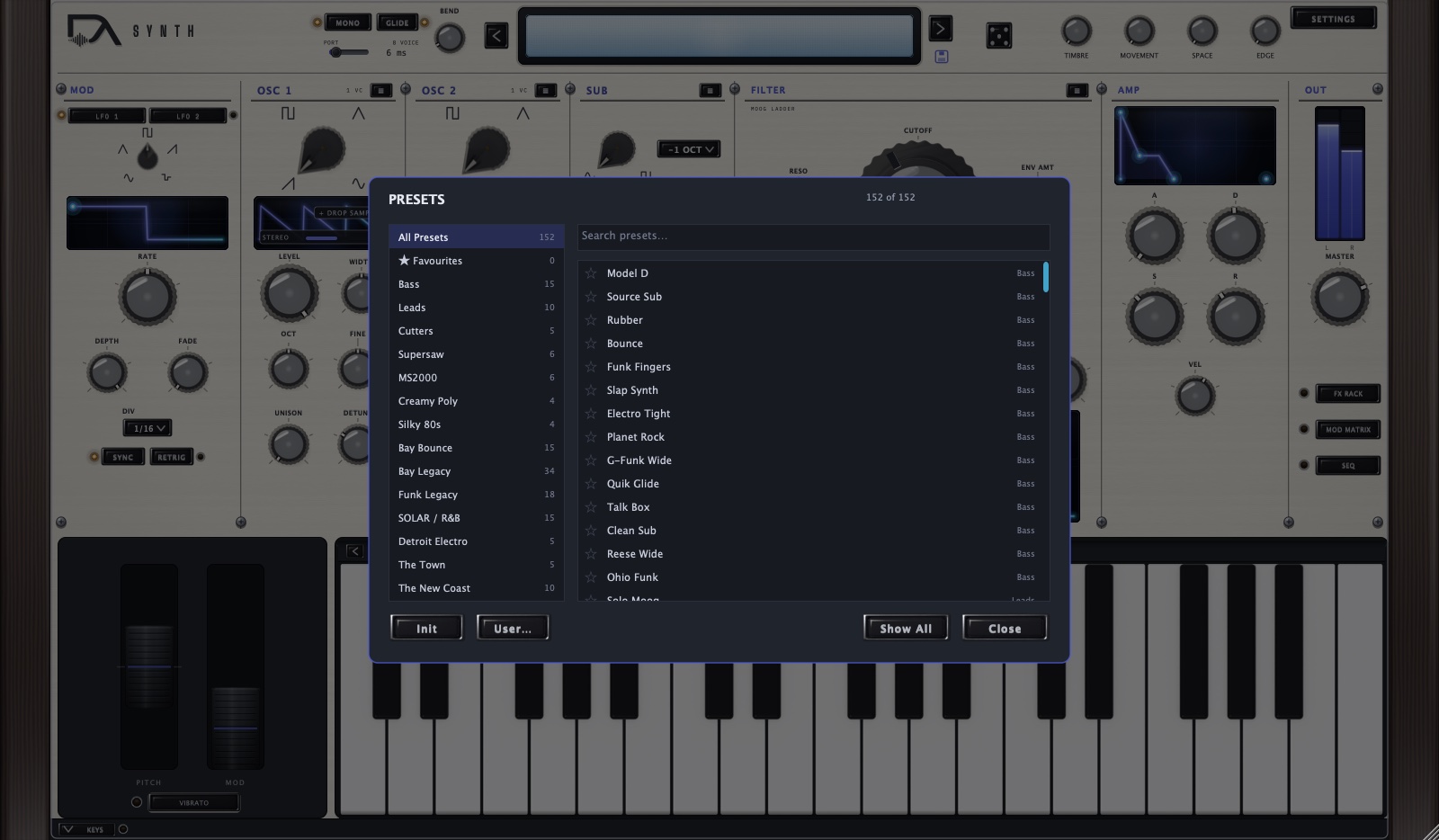
Exhibit · the filter
With the oscillators down and resonance up, the filter is the instrument — that singing sine is a sound you play, not a side effect. It worked from the first build, and it could not start.
A pristine digital ladder fed exactly zero stays at exactly zero forever. Real analog starts on thermal noise, so this one has noise: ±5×10⁻⁷, about −126 dBFS — a decade above the measured start threshold, some 60 dB below the oscillation's own harmonic residue, and around 100 dB below normal signal. The seed only breaks the zero; the saturation inside the loop sets the level, which is why 0.0005 and 0.002 settle to the same fundamental.
Ladder · measured
The onset is exactly the theoretical Moog threshold. The seed is enough to start the oscillation, never enough to hear.
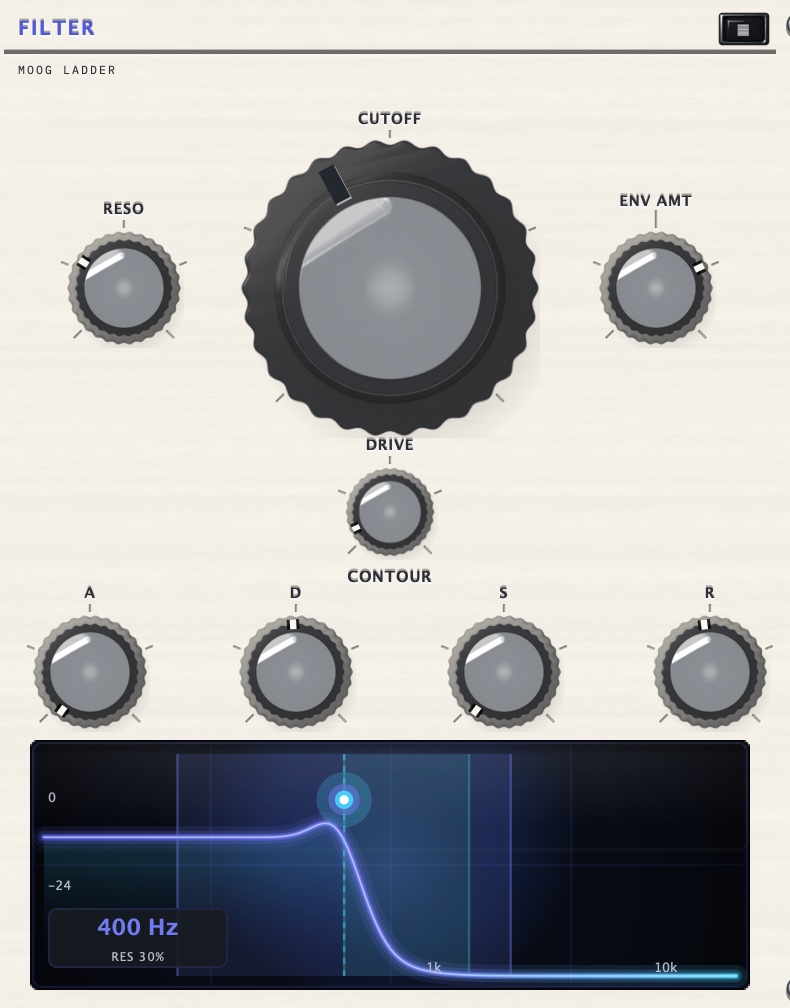
Exhibit · the bank
A bank you can audition is worth more than a bank you can brag about. A library that jumps 17 dB between patches makes you ride the fader instead of listening, so level is part of the design rather than an accident of voicing.
I measured all 152, set a house median, and trimmed 92 into a band of ±1.5 LU: the spread fell from 17.4 LU to 3.0 LU. Master feeds the warmth stage here, so a trim is never only a trim — 27 presets changed character and were re-auditioned rather than assumed fine.
Three refused the standard and are documented rather than forced. Laser Zap cannot satisfy both the loudness band and the percussive-decay cap. Hypersaw Stab clipped worse when raised, which points at its voicing, not its level. Perc Hit's chord runs 4.9 dB hotter than its single note at every setting. All three ship at their original values, on the list for the next pass.
Preset changes are verified by re-rendering all 153 programs and comparing audio hashes. A change that is supposed to be cosmetic has to move zero samples.
Loudness spread, before and after
92 of 152 presets trimmed · 3 documented exclusions · 27 re-auditioned because master feeds the saturator.
Exhibit · the output stage
This stage is the only ceiling in the instrument, and it is also most of its glue — the thing that makes a stacked chord sit together instead of piling up. Its curve is not a taste setting: it decides how much colour the instrument has and how clean it stays.
Higher exponents widen the linear range, which is what you want — but this stage runs at base rate in Draft quality, and from n = 6 up it aliases worse than the plain tanh it replaced. Four is the last value that widens the range and still improves on the baseline.
Underneath it is arithmetic, not judgement: with a low-level gain of 7.92 and a ceiling of 0.99, the curve has to leave its linear region at −18.1 dBFS. Nothing escapes that, so headroom comes from the per-preset trim. The cost sits in the source beside the constant — at −20 dBFS the third harmonic thins by 6.5 dB; at working level it moves 0.33 dB.
In-band aliasing, measured
| Curve | Aliasing |
|---|---|
| plain tanh | −42.4 dB |
| n = 3 | −50.4 dB |
| n = 4 | −48.0 dB |
| n = 6 | −41.6 dB |
| n = 10 | −37.6 dB |
n = 3 measures better; n = 4 keeps more of the linear range. Everything from 6 up is worse than the curve it was meant to improve.
The panel
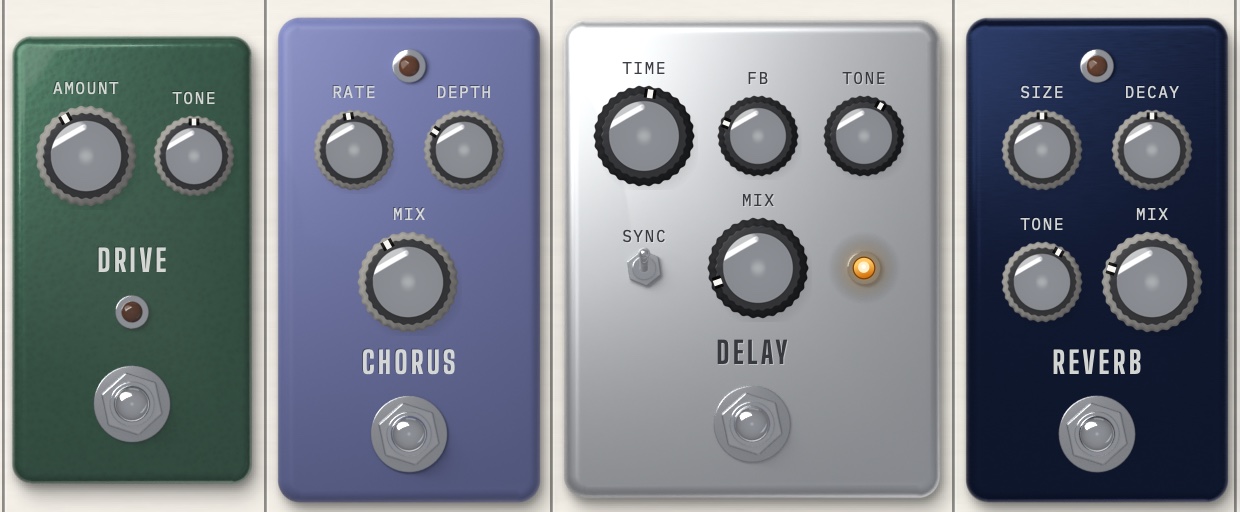
A drawn knob reads as software; a lit one reads as a thing you could pick up. So the panel is rendered: 45 assets, 4.7 MB of them — knob bodies and caps, the keybed, the walnut cheeks, and 16 pedal enclosures, four pedals across four faceplates. Enamel, brushed aluminium and painted steel don't take light the same way, so they weren't given the same highlight.
The low-shelf tone control is measured too. 138 Hz at Q 1.0 is the exact curve taken off the Logic channel EQ that was being used on the bass patches before it was built into the instrument, and +6.3 dB was that setting's gain. The range runs to +9, leaving room above the target without inviting damage.
Nothing in it was recorded. Every sound it makes, it makes.
Artwork, counted
The weight in the download is artwork and code. Nothing in it was recorded.
Where it's small
All of this is findable in ten minutes. Here it is in one.
If you want the synth that does everything, this isn't it. What it does instead is one sound, deeply, with the workflow that sound needs — and every number on this page came from a measurement, not an impression.
DeAnalog Synth
AU · VST3 · Standalone — macOS, Apple Silicon and Intel.
Get NotifiedOne email at launch. Nothing else, ever.